
Ash Dieback
Ash Dieback is a deadly fungal disease caused by Hymenoscyphus Fraxineus (formerly Chalara Fraxinea), which primarily affects Ash trees (Fraxinus species). The disease leads to leaf loss, branch dieback, bark lesions, and eventual tree death. It has devastated ash populations across the UK, Europe, and parts of North America, causing severe ecological and economic losses.
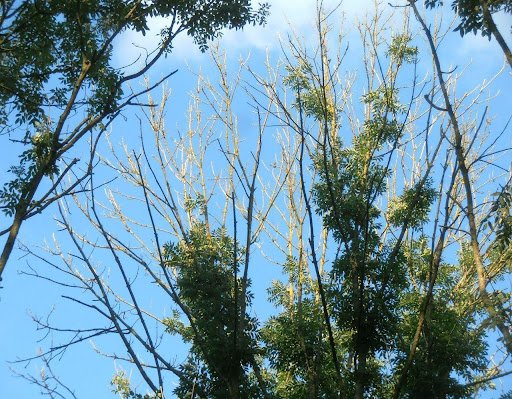
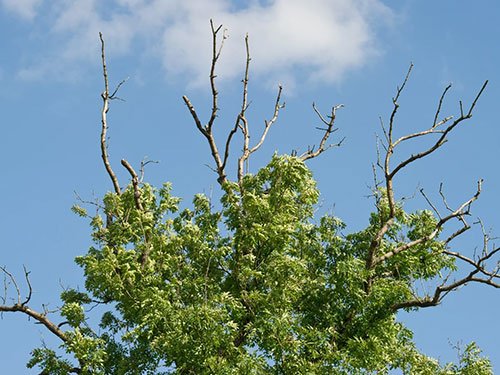
1. Symptoms of Ash Dieback
A. Early Symptoms
• Black or brown lesions (sunken dead areas) appear on young shoots and leaves.
• Wilted or blackened leaves that remain attached to the tree.
• Leaves may develop brown patches and curl inward.
B. Progressive Symptoms
• Dieback of branches, starting in the upper canopy.
• Bark lesions (cankers) develop on stems and branches, often with a diamond shape.
• Epicormic growth (new straight shoots from latent buds growing from the main stems, limbs and primary branches) as the tree tries to survive.
C. Advanced Infection
• Severe crown thinning and widespread dead branches while growth concentrates increasingly towards the centre of the tree crown.
• Secondary infections (like Honey Fungus) invade weakened trees.
• Tree collapse due to extensive decay and structural weakness.
2. Causes and Transmission
• Airborne Spores: The fungus spreads through wind-dispersed spores, especially in late summer and autumn.
• Infected Leaves & Debris: Spores land on ash leaves, then spread to twigs and stems.
• Tree-to-Tree Spread: The disease can move between trees in forests, woodlands, and urban areas.
3. Trees Affected
• Primarily affects European Ash (Fraxinus Excelsior).
• Other Fraxinus species (including North American Ash) may show varying resistance levels.
4. Management and Control Strategies
A. Preventative Measures
• Plant Disease-Resistant Ash Trees: Some ash trees show natural tolerance to the fungus.
• Avoid Moving Infected Wood: Do not transport ash logs, branches, or leaves, as they may carry spores.
• Promote Tree Health: Healthy trees are more resistant—provide proper watering, mulching, and avoid unnecessary stress.
B. Managing Infected Trees
• Prune Out Early Infections: Removing affected twigs and branches may slow the spread.
• Monitor for Structural Weakness: Severely infected trees become brittle and prone to breaking, posing a hazard.
• Tree Removal: If over 50% of the crown is affected, removal may be necessary, especially in public areas.
C. Fungicide & Biological Control
• No chemical cure exists for Ash Dieback.
• Ongoing research explores biological controls, including fungal competitors that may reduce infection rates.
5. Ecological & Economic Impact
• Massive Ash Tree Loss: Up to 90% of European ash trees may die from the disease.
• Impact on Biodiversity: Ash trees provide habitat for hundreds of species—their decline affects entire ecosystems.
• Timber & Forestry Industry Losses: Ash is a valuable wood for furniture, tools, and construction.
• Increased Safety Hazards: Dead ash trees pose falling risks in urban areas, roadsides, and forests.

