
Armillaria
Armillaria root rot, also known as Honey Fungus, is a destructive fungal disease caused by Armillaria species, primarily Armillaria Mellea. It affects a wide range of trees and shrubs, leading to root decay, trunk rot, and eventual tree death. This disease is particularly dangerous because it spreads through underground rhizomorphs (black fungal structures resembling roots but with a black centre, hence the name Black Boot Laces, allowing it to infect multiple trees over time.
1. Symptoms of Armillaria Infection
A. Early Symptoms
• Yellowing and wilting of leaves
• Stunted growth and reduced fruit/flower production
• Premature leaf drop
B. Advanced Symptoms
• Dieback of branches starting from the top down
• Cracked or peeling bark
• White fungal mycelium (fan-like growth) under the bark near the base of the tree
• Gummy or resinous exudate (sap leakage) in some tree species
• Soft, rotting wood at the base or underground roots
It should be noted that symptoms may be mild even in trees with roots have been degraded to a foamy pulp and highly susceptible to wind-throw(uprooting).
C. Fruiting Bodies (Honey-Coloured Mushrooms)
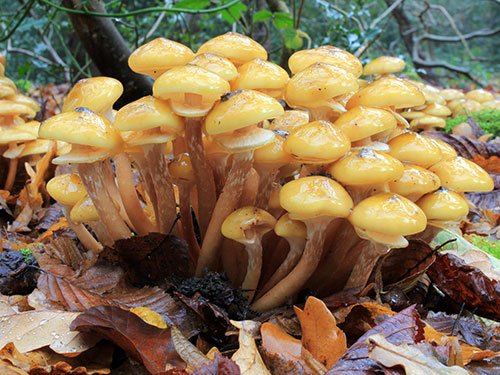
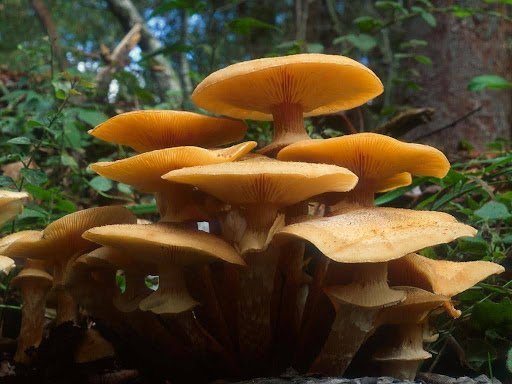
• Clusters of yellow-brown mushrooms appear at the base of the tree or near infected roots in autumn.
• These mushrooms have a distinctive “honey” colour, often with a scaly cap and white gills underneath.
These should be bagged as if you were picking up a dog poo, so as not to release the spores into the air. As another check, once indoors open the bag and you should be able to smell honey.
D. Black Rhizomorphs (“Bootlace Fungi”)
• Thick, black, string-like fungal structures can be found growing between the bark and wood or in the soil around roots.
• These structures allow the fungus to spread underground to nearby trees.
2. Trees and Plants Affected
Armillaria affects hundreds of plant species, including:
• Hardwoods: Oak, beech, maple, cherry, and willow
• Conifers: Pine, spruce, cedar
• Fruit Trees: Apple, pear, citrus
• Ornamentals & Shrubs: Roses, rhododendrons, and azaleas
3. Causes and Transmission
• Soil-Borne Fungus: Armillaria spores and rhizomorphs live in the soil, infecting trees through roots.
• Root-to-Root Contact: The fungus spreads underground when infected roots touch healthy roots.
• Decaying Wood: The fungus survives on dead tree stumps, fallen logs, and buried roots for decades.
• Injuries and Stress: Drought, poor soil conditions, and mechanical damage make trees more vulnerable.
4. Management and Control Strategies
A. Prevention (Best Approach)
• Avoid Planting in Infected Soil: If a tree has died from Armillaria, avoid replanting in the same area.
• Improve Drainage & Soil Health: Proper aeration and mulching can reduce stress on trees.
• Minimize Wounds: Prune trees carefully and avoid damaging roots with machinery.
• Resistant Species: Some trees, like birch, larch, and certain pines, show greater resistance.
B. Managing Infected Trees
• Remove Infected Trees & Stumps: Complete removal of infected material helps reduce fungal spread.
• Excavate & Expose Roots: Armillaria thrives in moist, oxygen-deprived soil. Digging around the base of the tree to expose roots can slow fungal growth.
• Fungicide Treatments: Some systemic fungicides (e.g., phosphite-based products) may slow disease progression but will not cure an infected tree.
C. Biological & Cultural Controls
• Soil Solarization: Covering the soil with plastic to heat it and kill fungal spores.
• Introducing Beneficial Fungi: Some mycorrhizal fungi compete with Armillaria and can help suppress its growth.


